Circular Flow of Income Investigation
Instructions
The circular flow of income can be modelled like this:
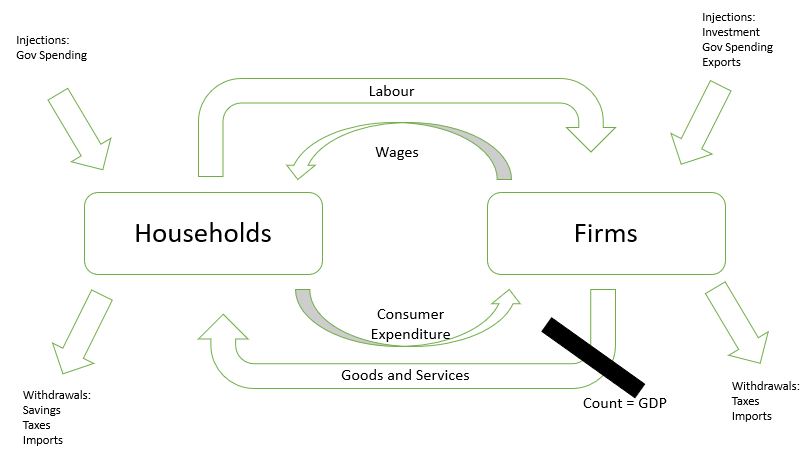
Households earn wages, which are spent on consumer expenditure, which is exchanged for products, which requires labour, for which households earn wages. And so the cycle continues.
Assume that this is a model where the only withdrawal from the circular flow is savings. We can describe the savings rate as the “Marginal Propensity to Save.” This is the percentage of any additional income that a household will take out of the circular flow and put back into savings.
Say we inject £10 into the circular flow of income. In Round 1, the first time it goes around, it will create £10 worth of income.
Once it gets to the households, some of it will be saved.
Say the Marginal Propensity to Save is 10%, or 0.1.
This means that when the £10 of income gets to the household, 10% of it, or £1, will be saved. That means that households only put back £9 back into the circular flow of income. So in Round 2, it will generate £9 of income.
And when this £9 of income gets to the household, they will save 10% of it, leaving less to go around in the next cycle.
The total effect of the initial is what happens after it goes around until it is saved down to nothing.
The multiplier is how many times we multiply the initial injection to get the total effect on the economy. If an injection of £10 creates £100 total effect in the economy, then the multiplier is £100 ÷ £10 = 10.
Task:
You will be investigating the effect of savings rate, or MPS, on the total effect of an initial injection of money into the circular flow of income. Using the controls below, you can set:
- The initial injection amount
- The Marginal Propensity to Save (MPS)
Each time you click “Add Row” you will see the effect of the injection going around the circular flow. The table will record:
- Income (this round): The amount of income in the circular flow in that cycle.
- Total Income (all rounds): The cumulative effect of this and all previous cycles on the overall economy.
Play around with the controls. Try to see if you can explain what the effect on total income is with low, medium, and high levels of savings. Then answer the following questions:
- What is the multiplier when MPS = 0.1?
- What is the multiplier when MPS = 0.5?
- What is the multiplier when MPS = 0.8?
- Fill in the following statement: The lower the savings rate, the __________ the multiplier.
- Extension: Can you work out an equation that relates the multiplier to the MPS?
| Round | Income (this round) | Total Income (all rounds) |
|---|