1.2.2 Equilibrium Stories (from The Economist)
Table of Contents
Britain’s Cocaine Glut
London’s Bubbly Housing Market goes flat
The perilous politics of parking
Carrying a child for someone else should be celebrated- and paid
The Merits of Going English
Raking it in
The French are fretting over a sudden butter shortage
Britain’s Cocaine Glut
7 December 2017
https://www.economist.com/britain/2017/12/07/britains-cocaine-glut
Cocaine in London in 2017 is much cheaper than it was five years ago. Dealers know that their product is no longer scarce, and many are resorting to discounts (e.g. “Black Friday discounts”) to boost sales.
The quantity of the drug consumed seems to be rising by most estimates. Between 2010 and 2016 the number amount of cocaine seized by the authorities doubled to 5.5 tonnes. Analysis of sewage in London shows that there is double the amount of substances which the human body produces after consuming the drug. The number of crack cocaine users rose by about 10% between 2011 and 2015.
Street prices have not changed, though wholesale prices have fallen by 15% between 2014 and 2016. (Street prices do not change because users already know the standard price per gram).
Why has this been happening? Colombia, a main producer of the drug, has increased its production of coca from 49,000 hectare in 2012 to 146,000 in 2016. The Colombian government also stopped spraying weed killer on coca fields from airplanes. Also, as part of the recent peace deal in Colombia farmers were given money to switch away from coca- but the farmers knew this beforehand, so they grew more coca before the deal was signed to get more money for switching.
Another factor is that demand in America is falling, due to users getting older and tougher crackdowns on trafficking from Mexico.
The cheaper cocaine has a human price- the number of deaths related to cocaine or crack in England and Wales jumped from 139 in 2012 to 371 in 2016.
- Draw a S/D diagram for the market for cocaine.

- Use information from the article to explain what is happening to supply of cocaine.
The supply of cocaine is increasing. Production in Colombia increased from 49,000 hectares in 2012 to 146,000 hectares in 2016.
The Colombian government has stopped spraying weed killer on cocoa fields.
Farmers were incentivised to increase their production before a peace deal.
Also, demand for cocaine is falling in the US market, meaning that more of the production may now be coming to Europe.
- Use this information to explain why the price of cocaine has fallen in recent years.
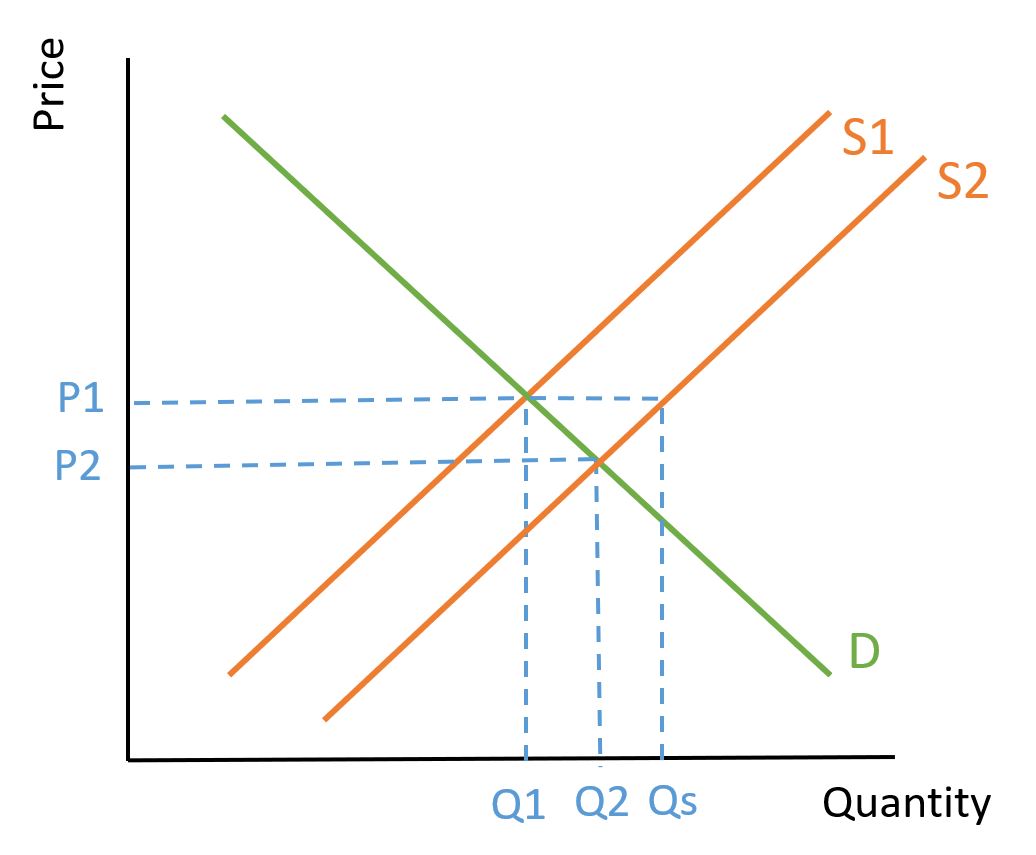
This increase in supply would shift the supply curve for this market to the right.
At old price P1 there would be excess supply.
This would put natural pressure on the price to decrease, causing an extension in demand and a contraction in supply.
This price decrease would continue until a new equilibrium is reached at Q2P2.
London’s Bubbly Housing Market goes flat
2 November 2017
https://www.economist.com/britain/2017/11/02/londons-bubbly-housing-market-goes-flat
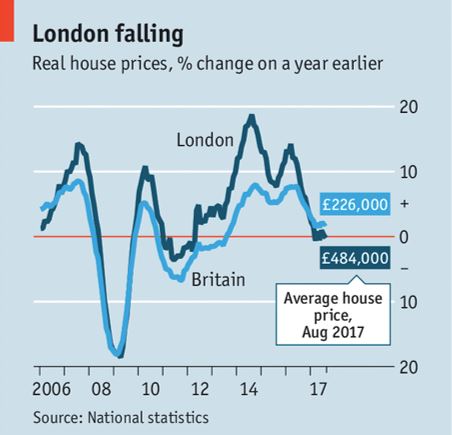
Since 1990 the price of an average house in London has tripled in real terms. But the market may be turning. The priciest 5-10% of homes have seen prices fall 15% below their peak in 2015. In some districts such as Mayfair and St James’s homes used to sell for more than £50m, but in 2017 the maximum was approximately £30m. Part of this is because of uncertainty surrounding Brexit. The government also put up stamp duty (tax) on houses worth more than £1m.
Houses in other price ranges have seen prices have been growing more slowly lately. Some blame an increase in supply: the building rate of new house in London has risen, and the projection for the number of new houses completed in 2017 was 46,500, above the target of 42,000.
New regulations on mortgages have also played their part. Banks can no longer lend so much to first-time buyers, which has meant that some people can no longer purchase a house.
- Draw a supply and demand diagram to show what the effect of more house building in London will have on the London property market.
More house building in London would push the supply of houses to the right.
This would have the effect of decreasing prices.
At old price P1 there would be excess supply.
This would put natural pressure on the price to decrease, causing an extension in demand and a contraction in supply.
This price decrease would continue until a new equilibrium is reached at Q2P2.
In the context of this article this is explained as house prices “have been growing more slowly”.
- Draw a supply and demand diagram to show what the effect of the new mortgage regulations will have on the London property market.
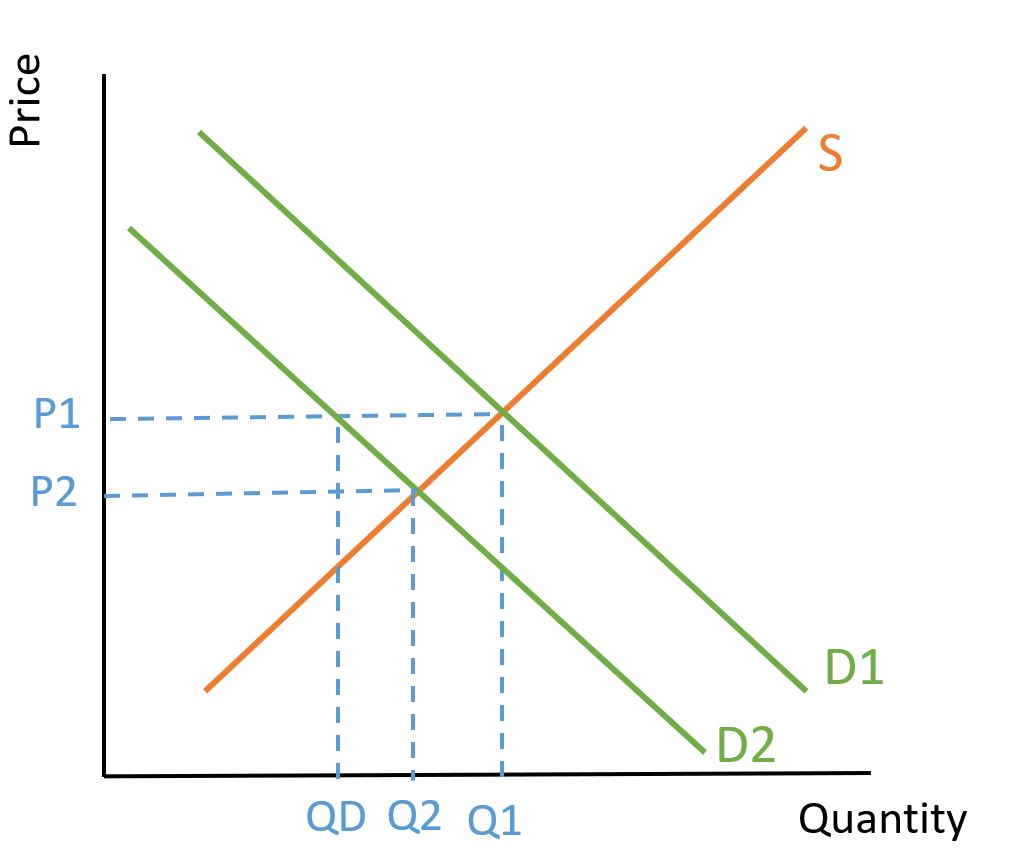
The new mortgage regulations have affected the demand for homes in London.
Because a mortgage is a complementary good to owning a home (people need mortgages to purchase a home), the restrictions in this market will cause Demand in the market for houses to shift left.
At old price P1 there would be excess supply.
This would put natural pressure on the price to decrease, causing an extension in demand and a contraction in supply.
This price decrease would continue until a new equilibrium is reached at Q2P2.
The perilous politics of parking
6 April 2017
https://www.economist.com/leaders/2017/04/06/the-perilous-politics-of-parking
Think of parking as an economic good- it is supplied, either by the government or through private individuals who are forced to create parking when they build new buildings, and it is demanded by drivers, who sometimes often have to pay for it. Space given to parking lots certainly has an opportunity cost- just think of the other parks or buildings that could be used on the land instead.
In many places people can park on the street for nothing, or for very little. In Boston, MA, most meters charge $1.25 per hour. Because drivers spend so long looking for these great deals, many end up circling the block. In the German city of Freiburg one study found that 75% of all cars on the road were simply looking for a place to park.
In order to increase parking spaces, many cities require developers to build new parking whenever they build a new building. In St Paul, MN, there must be four spaces for every hole on a golf course. The new Apple HQ in California has 318,000 square metres for office and laboratories; the city of Cupertino has a law that required them to build 325,000 square metres of cark parks.
Cities should stop trying to increase the supply of parking and instead should raise the prices until the streets and car parks are nearly, but not quite, full. This would help speed the transport revolution that will come about from self-driving cars.
- The supply curve for parking will be vertical. Explain whether you agree with this view.
In the short term it could be argued that the supply curve for parking is vertical because there is only a certain amount of parking available at any given time.
In the long term, however, one might argue that the supply of parking would increase with price. Higher priced parking spaces might convince people to convert buildings into parking garages or turn vacant lots into car parks.
- The article describes how government policies force developers in the USA to build parking spaces with new buildings. Explain the effect this will have on the supply of parking.
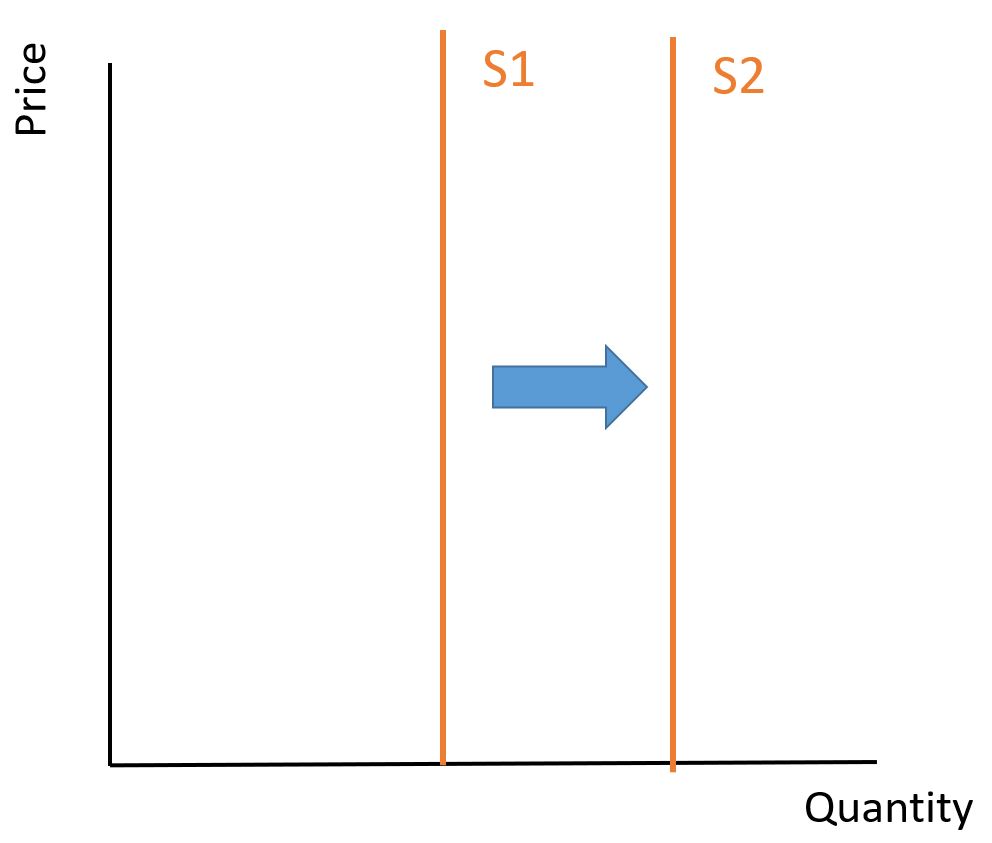
Forcing developers to build parking spaces when they build new buildings will shift the supply curve to the right.
- Boston, MA charges $1.25 per hour. Use information from the article to show the effect of this on a supply/demand diagram.
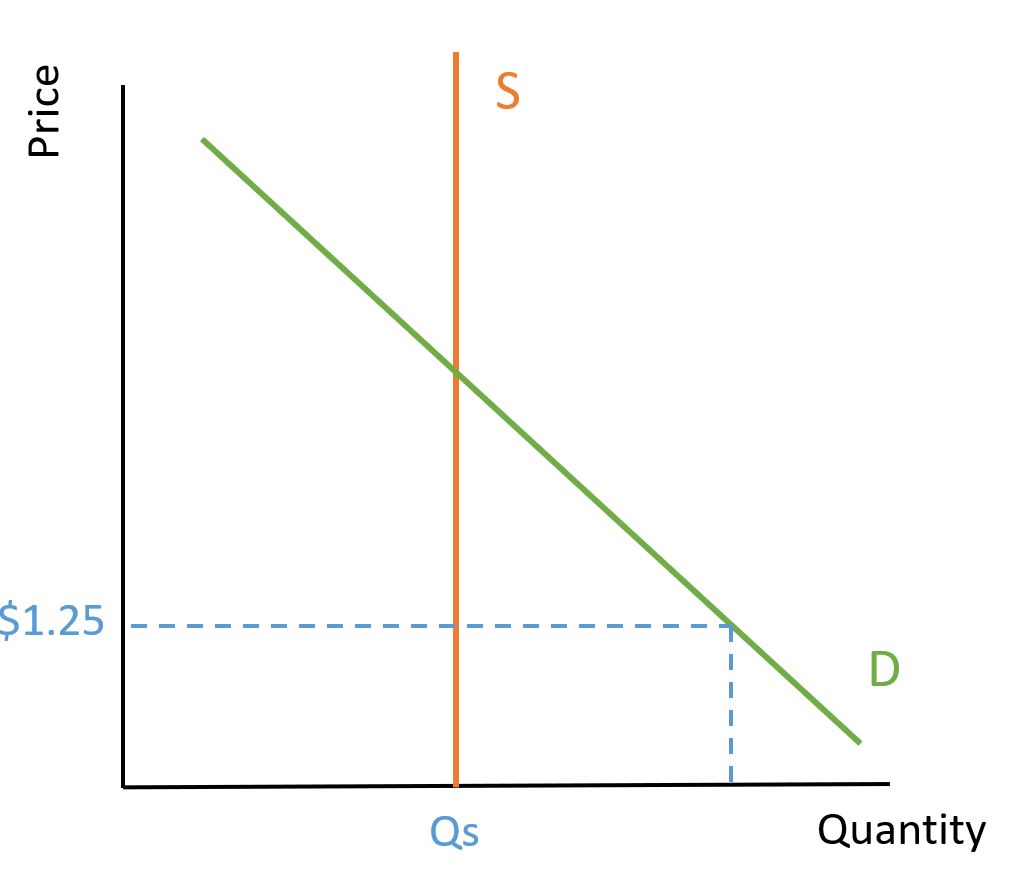
There is evidence in the article to suggest that at $1.25 per hour, there is excess demand. There are too many drivers looking for too few spaces, and they end up circling the block.
The diagram shows the effect of this: a price which is too low, and too many people looking for spaces.
If the market were allowed to reach equilibrium, then the price would be higher.
- Evaluate whether car parking should be more expensive in cities.
This article gives a strong perspective that parking should be more expensive in cities. The suggestion is that too much parking is built on land which has opportunity cost. In other words, the land that is currently used for parking spaces could be better used doing something else.
The counter-argument would be that free parking facilitates driving into cities at lower cost, enabling workers to travel and helping economic growth.
The conclusion of the article is that parking should certainly be more expensive in cities. This would use the price mechanism to signal to consumers (drivers) that they should ration their use of parking, encouraging them to use other modes of transportation (such as public transit) that would produce fewer negative externalities.
Carrying a child for someone else should be celebrated- and paid
13 May 2017
A surrogate mother carries and gives birth to a baby for another person or couple. The baby is usually comes from embryos that are created in vitro with eggs and sperm from the commissioning parents or donors.
Many countries ban surrogacy. Many countries ban payments made to women who would like to act as a surrogate mother.
Demand for surrogate mothers has risen in recent years. Part of this is due to the spread of gay marriage and male couples using surrogate mothers to complete their families.
Women who become surrogates generally take great satisfaction in helping people become parents. Some argue that providing this service should be paid, as it would allow more surrogate mothers to be available for the new rising demand.
- Use draw a supply diagram for surrogate mothers, assuming that it is illegal to pay women to act as surrogates (as it is in most states). Adapt the diagram to show what would happen if payment were allowed to surrogate mothers.
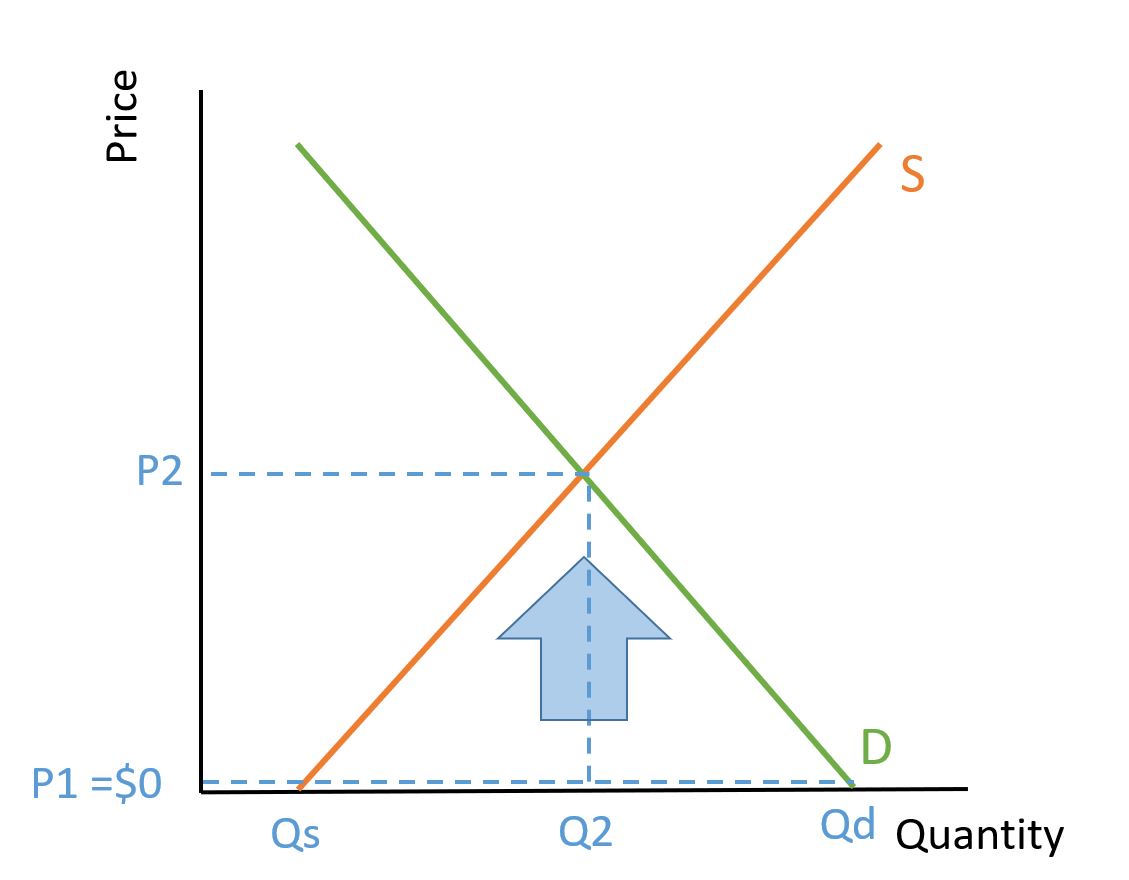
A market with no payment allowed suggests that the price is P = zero.
At this price, there is excess demand.
If payment were allowed to be made to surrogate mothers, this would mean that price could be above zero. The higher price would extend the supply curve as more women entered the market to be paid to act as a surrogate. The high price would contract the demand. Eventually the market would clear and equilibrium would be reached at Q2, meaning more people would be able to have babies through surrogacy.
- Explain what has been happening to the demand for surrogate mothers.
Demand is increasing.
The article mentions that gay marriage allows married male couples would hire surrogates to carry a baby.
This would shift the demand curve to the right.
- Assuming that people are allowed to pay women to act as surrogate mothers, draw a Supply/Demand Diagram to show what will happen following this shift in demand.
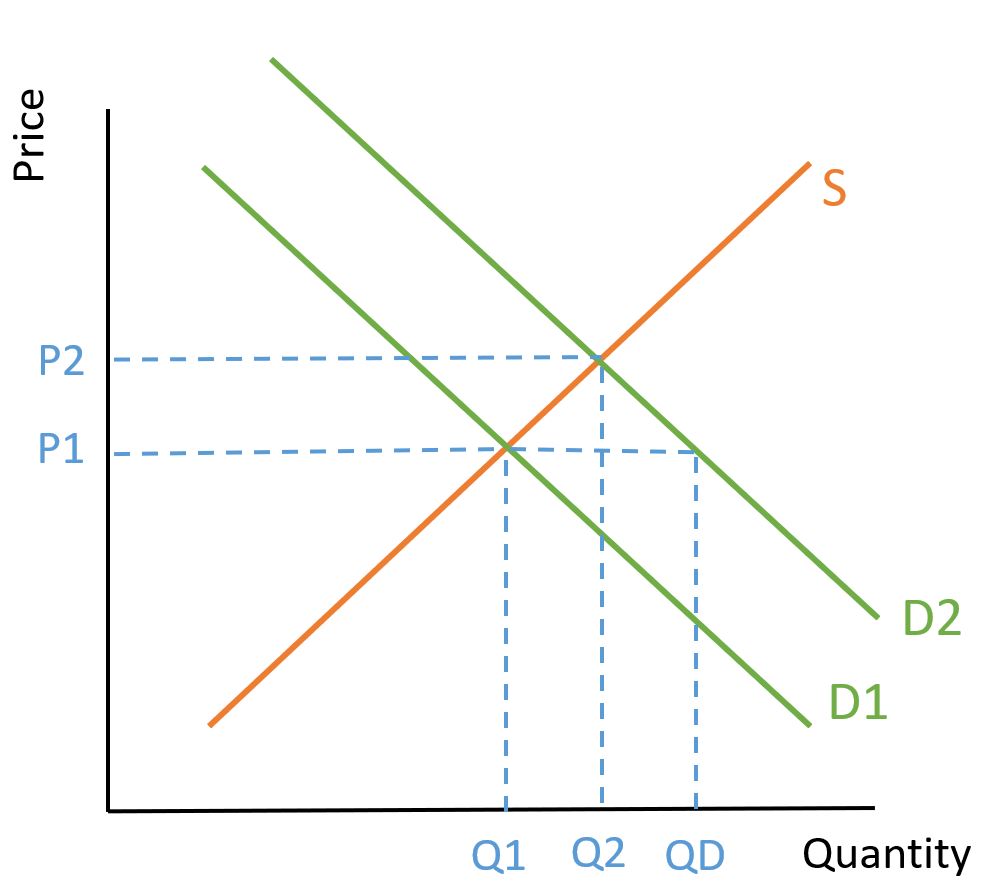
A rise in demand would create excess supply at P1.
This would put upward pressure on prices. The higher prices would encourage more suppliers onto the market, causing an extension in supply.
The rise in price would discourage consumers from purchasing the good, causing a contraction in demand.
The price would continue to rise until supply= demand and the market clears.
- The rising price will cause an extension to supply. Explain what this means in terms of surrogate mothers.
At higher prices, more women would be incentivised to become surrogate mothers as they can earn money from it. There would be more surrogate mothers on the market.
- Extension: Do you believe that women who act as surrogate should be paid? Evaluate this position.
On the one hand, allowing payment for being a surrogate mother would encourage more women to supply to the market in this way. This could be beneficial to couples who would like to have babies but require a surrogate mother to do so.
On the other hand, allowing payment might encourage exploitation of women in this market.
It depends on whether the market could be regulated to ensure that vulnerable women are not exploited and forced to join the market.
The Merits of Going English
10 August 2017
https://www.economist.com/leaders/2017/08/10/the-merits-of-going-english
Twenty years ago students could go to university for free; the government paid the cost. This meant that many institutions struggled financially, and there were strict limits on the numbers of students universities were allowed to take. Since then universities have been allowed to raise fees, gradually up to £9,000 in 2012. This has meant that higher education now extends to 40% of 18-year-olds, up from 30%.
Loans for university students are generous: graduates only start to pay once they make over £21,000 per year, and after 30 years the loan is written off. The argument against going back to a system without student fees is that wealthy students, who could have paid anyway, will benefit from general taxation while poorer students will not be able to access courses because universities will not be willing to offer them.
- As the price of university education has increased, what has happened to the number of courses?
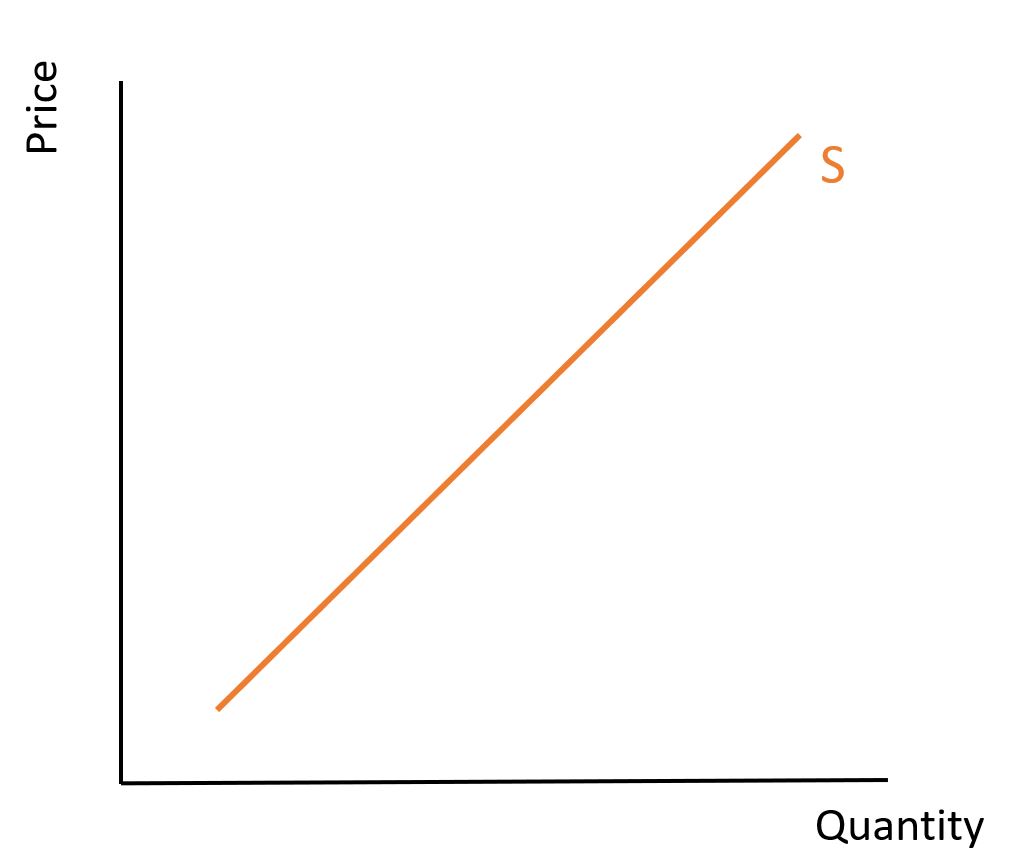
The number of courses has increased with price. The higher price has made these courses more financially viable for universities to offer. This would be described by a typical supply curve.
- Explain how the loan structure for university students will affect the demand for university places.
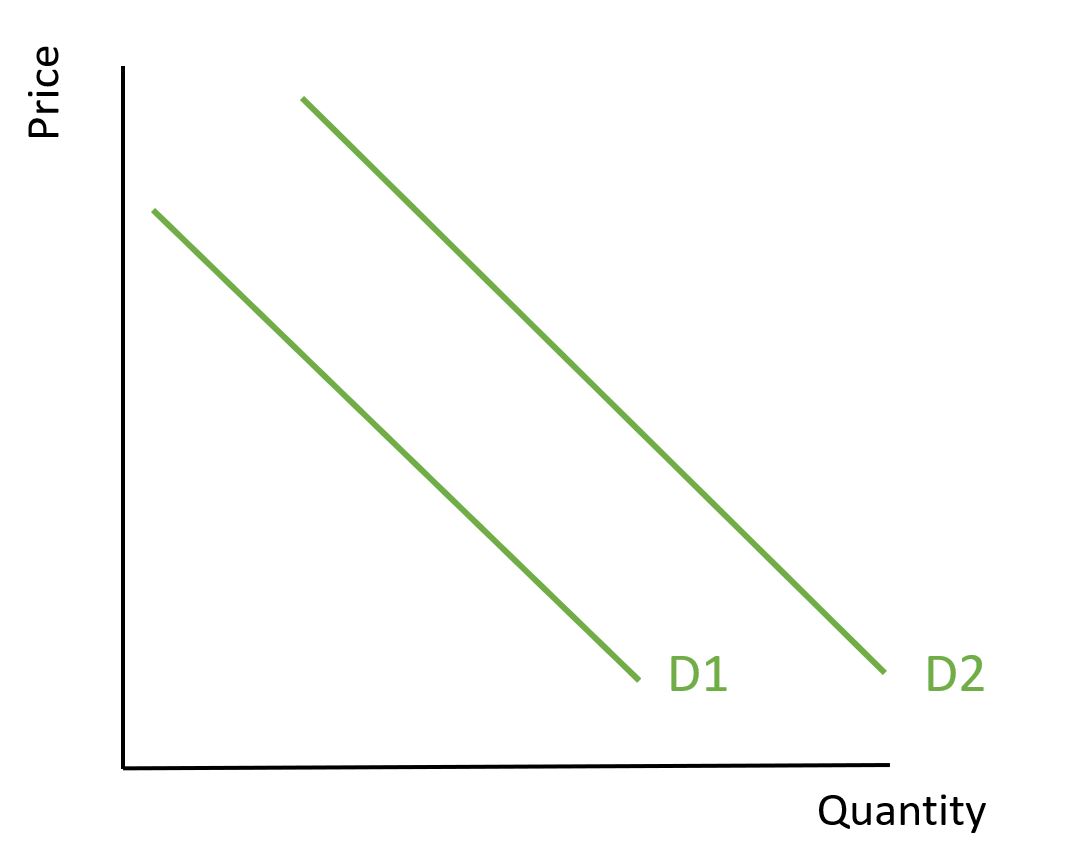
A loan to attend university is a complementary good to the university course.
The increased availability of loans will allow more students to demand places at any given price.
This will shift the demand curve to the right.
- Do you think that university tuition fees (the price of university) should be lowered? Justify your answer.
On the one hand, lower university fees would allow more people to access university, especially from lower-income groups. This would lead to lower levels of inequality.
On the other hand, low prices of university would mean that fewer courses are on offer. As is mentioned in the article, higher university prices means there are more courses, which as increased the number of people who go on to university.
It depends on whether there is a fair way to finance the higher costs of university.
Raking it in
4 October 2014
https://www.economist.com/britain/2014/10/04/raking-it-in
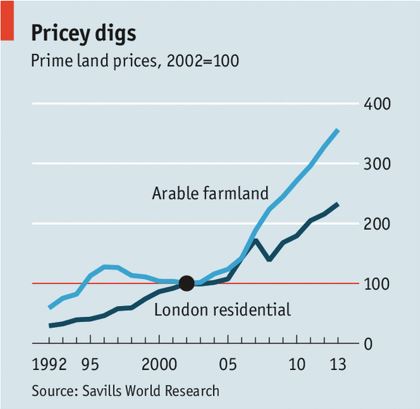
The hottest property investment in the UK is where you may least expect it- arable farmland. Over the past decade farmland prices have grown at twice the rate of prime London property prices. Farmland in the UK is 3 time as much as in America, and 15 time as much as farmland in Australia.
One reason is that people just aren’t selling it. In 2000 300,000 acres were on the market, but last year it was below 150,000, or less than 0.5% of Britain’s farmland. Another reason is that climate change is affecting food supply abroad, which makes British farmland more attractive. Tax breaks on owning farmland help because farmland is exempt from inheritance tax after seven years as long as the farmer farms it.
Foreign investors and pension funds are attracted to farmland because it is seen as a good investment, particularly in a recession. Farmers are growing richer as well, due to rising prices in their crops (wheat was 80% more expensive in 2014 than it was in 2009) and are buying more farmland from golf-course developers. Farmers themselves in 2014 made up 66% of buyers, up from 40% in 2004.
This trend is set to continue, as the supply of farmland shrinks every year. The only thing that makes it look like this growth will slow could be that prices of crops may fall soon. This will be due to the increased number of producers of these crops, which would push down their price.
- Find all instances in that describe shifts in demand for arable farmland.
Climate change makes British farms more attractive compared to farms abroad (right shift in demand)
Tax breaks on inheritance on farmland makes it a nice investment (right shift in demand).
Foreign investors and pension funds are buying it as an investment (right shift in demand).
Farmers are getting richer (right shift in demand).
- Use a supply-demand diagram to explain why the price of crops are predicted to fall in the future.
More suppliers of crops on the market will shift the supply of crops to the right.
At old price P1 there would be excess supply.
This would put natural pressure on the price to decrease, causing an extension in demand and a contraction in supply.
This price decrease would continue until a new equilibrium is reached at Q2P2.
The French are fretting over a sudden butter shortage
4 November 2017
https://www.economist.com/europe/2017/11/04/the-french-are-fretting-over-a-sudden-butter-shortage
There was a catastrophe in Paris in 2017: butter prices soared. Bakers have been able to keep their production of croissants (which use lots of butter), but they are making lower profit margins because the cost of butter is so high.
In some places, such as local supermarkets, there are butter shortages. Some consumers are hoarding what they can find. Butter is essential for much French cuisine, and the French eat more of it than anybody else.
Some part of this explanation is that demand is growing from other parts of the world. “China has discovered croissants,” says Emmanuelle Auriole of the Toulouse School of Economics. Others in western countries are buying more full-cream milk, cheese, and butter as they become more informed of the dangers of alternatives such as sugar.
A global dairy-price index is up by 27% in a year. However, suppliers have responded slowly to the rise in price because recent reforms made it harder for them to plan production.
One solution would be for French cooks to look to alternatives instead of butter. One reporter asked a baker whether she might try to bake with margarine. “We use butter or nothing,” the baker responded, wagging a finger. Clearly this would be unacceptable.
- Use information from the article to decide what the supply curve for butter would look like.
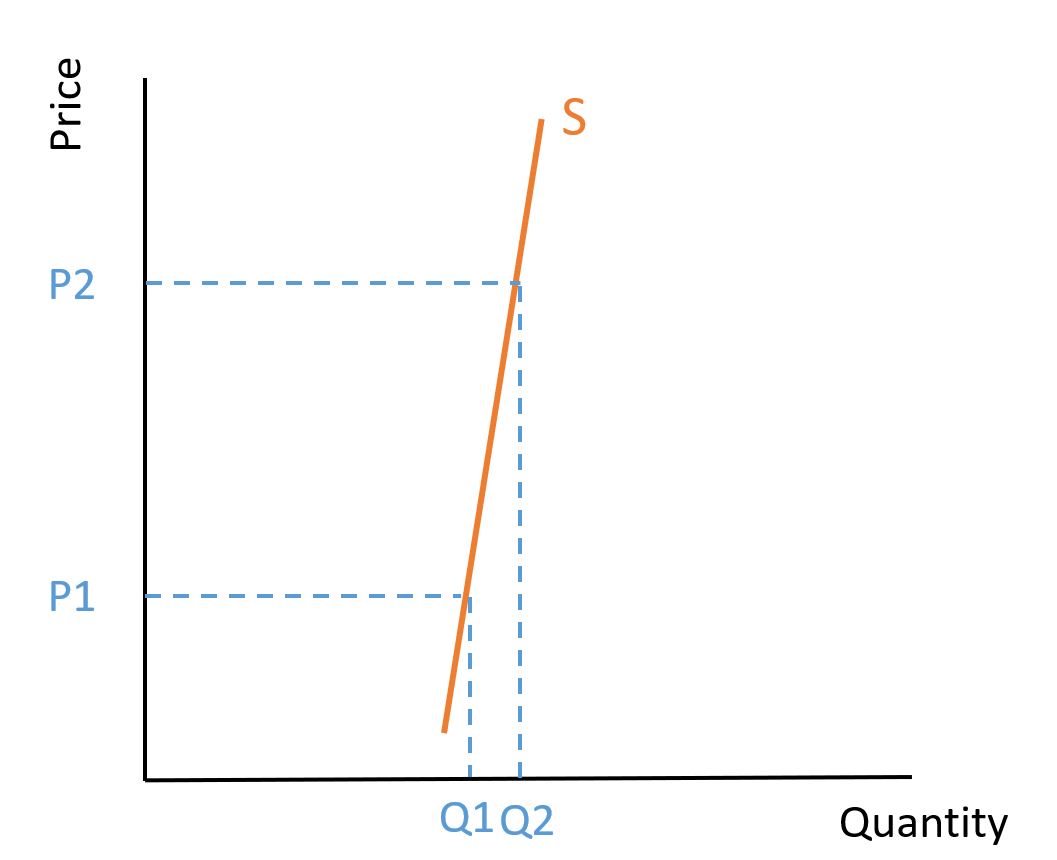
The article mentions that prices have risen by 27% in a year. However butter producers have not ben able to increase their production.
The supply curve would be very steep (price inelastic supply). This is because the higher price has produced a less than proportional response in quantity supplied.
- Use a supply-demand diagram to explain why the price of butter increased so much in 2017.
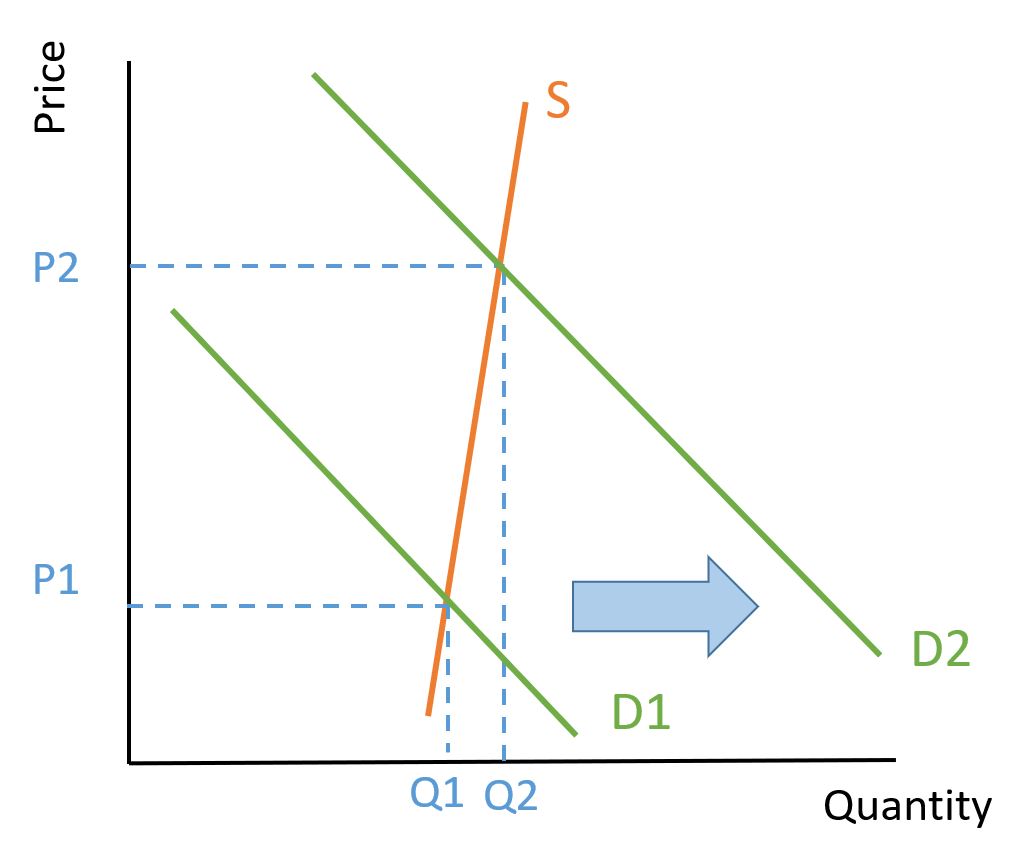
Demand for French butter has shifted right.
Chinese consumers are now eating croissants, which requires butter.
Consumers in other parts of the world are demanding more full-cream dairy products as they realise the dangers of alternatives such as sugar.
As demand shifts right in a market with a steep supply curve, the price of the good increases greatly.
- Explain whether butter and margarine would be considered strong or weak substitutes, given the information in the article.
The article suggests that butter and margarine are weak substitutes. As one baker said: “We use butter or nothing.” Margarine will not substitute in this context.